ESS Insulation Kit: Busbar & Harness
Pack and rack insulation quoted from your drawing or BOM: busbar casing, harness sleeving, sealing and fire protection, itemized per position and shipped with batch documentation.
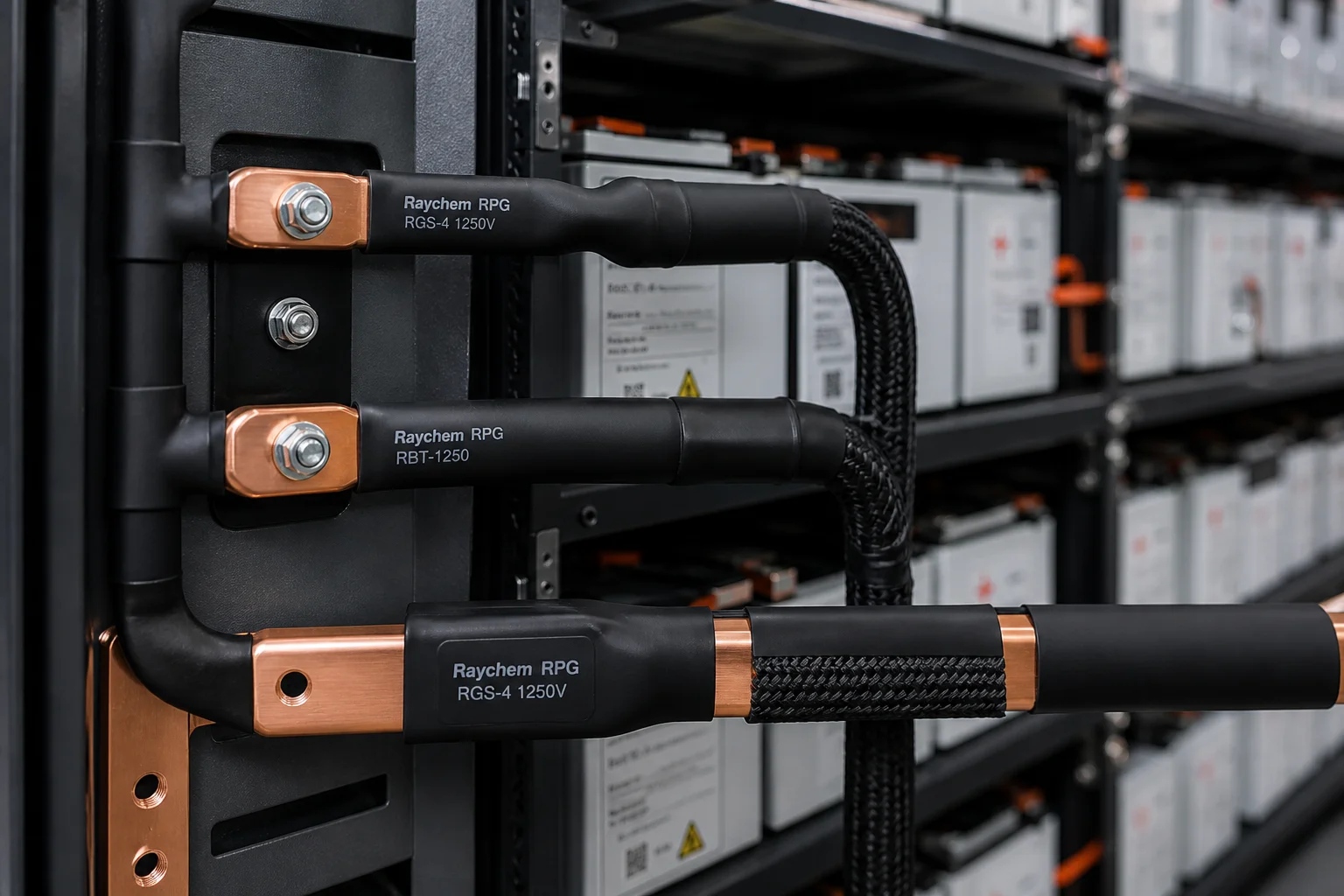
What we supply
Wellele is the export brand for the ESS insulation range on this page. Manufacturing is coordinated through operations in Suzhou and Anji, China; the manufacturing location and documentation scope for a specific part are confirmed with the quotation. If your rack drawing needs something we do not list, ask: if we cannot supply it, we will tell you straight instead of bidding a promise.
Component zones in a pack or rack
An ESS container mixes four insulation jobs. They fail differently, so they are specified and tested differently:
- Busbar zone : heavy-wall casing over DC busbars and connections. The busbar tubing carries its own published rating: 8.7/15kV medium wall (ID Φ20–180mm) and 26/35kV thick wall (ID Φ30–200mm), both cross-linked polyolefin to ASTM D2671, -55℃~+125℃. Component ratings are AC-class notation : for DC pack applications the dielectric duty is your engineering input, and we confirm the component against your calc, not against a system claim.
- Terminal & connection zone : adhesive-lined seals where lugs, splices and connectors meet cable: 3:1 and 4:1 dual-wall tubing (UL 224, up to 600V, -45℃~+125℃) recovers over the barrel and melts the adhesive into the cable jacket.
- Harness zone : continuous sleeving over HV harness runs: silicone-coated fiberglass sleeving (-60℃~+200℃, UL 1441) where cells raise ambient temperature, and PTFE heat-shrink tubing (up to +260℃) at the hottest positions.
- Edge & fire zone : cell-edge insulation and fire barriers on battery-level cable runs: the aluminum-foil fiberglass fire pipe is rated up to 1000°C short-term. Grounding identification tubing (green-yellow) is available on request : confirm it in the BOM review, as it is quoted per rack standard.
These zones map to different test evidence: busbar casing to dielectric and tracking data, harness sleeving to temperature and flammability data, fire pipe to its exposure rating. Do not accept one blanket "ESS certified" claim from any supplier: ask which test backs which zone.
Illustrative kit BOM structure
Every kit is itemized. The structure below is an anonymized example of how a rack BOM converts to an item list: your actual list comes from your drawing:
| Zone | Component family | Size basis | Spec basis |
|---|---|---|---|
| A : Busbar | Heavy-wall casing, cut lengths | Bar width × thickness → recovered ID | ASTM D2671 |
| B : Connections | 4:1 dual-wall tubing | Lug barrel OD + cable insulation OD | UL 224 |
| C : Harness | Silicone-coated fiberglass sleeving | Harness bundle OD + length per run | UL 1441 |
| D : Fire / edges | Foil fiberglass fire pipe, cut lengths | Run diameter + fire-section length | Exposure rating per product data |
| : | Marking / grounding ID items | Per rack standard | Confirmed at BOM review |
Kit items are confirmed against the pack drawing or BOM: part, size, material, quantity, cut length and marking. You approve the item list before production: no surprises in the crate.
Inspection & kitting workflow
The workflow from drawing to crate is fixed so that batches stay comparable:
- Drawing / BOM intake : you send the pack or container drawing, voltage class, temperature zones and annual quantity.
- Item list return : we return the itemized kit list with sizes, materials, cut lengths and the spec basis for each line.
- Approval : you approve the item list; that list is the quotation and production basis.
- Production & batch documentation : items run per batch; the specific inspection and test scope is confirmed in the quotation and stated in the order documents.
- Kitting : components are packed per BOM line, labelled by item, so your line-side crew picks by zone.
- Shipping documents : the documentation scope agreed at order time travels with the shipment per the order.
Key reference data
Busbar casing
Dual-wall sealing
Harness sleeving
Fire protection
Flammability evidence
Documentation
Select by application
ESS busbar insulation
Battery pack HV harness
Connection sealing
Fire-rated cable runs
Edge & general protection
Grounding identification
Frequently asked questions
What information do you need for an ESS insulation kit quote?
The pack or container drawing (or BOM), the DC voltage class of the system, the temperature adjacent to the cells and busbars, annual quantity, and the documentation your quality team requires per batch. We return an itemized kit list with sizes, materials and cut lengths as the quotation basis.
Do you supply test reports with the order?
Batch documentation is part of the ESS workflow: dielectric, flammability and dimension results are measured and filed per batch, and the report set that ships with the goods is agreed at order time. Datasheets are available before ordering. Flame values are quoted against named test methods, not generic ratings.
Are the products UL certified?
Parts of the range carry UL file recognition, for example the dual-wall adhesive tubing is built to UL 224 and the silicone-coated fiberglass sleeving to UL 1441. Coverage is model-specific, so confirm the exact items in your kit with our engineers before ordering.
Where are the products made?
Manufacturing is coordinated through operations in Suzhou and Anji, China; Wellele is the export brand. The manufacturing location for a specific part is confirmed with the quotation.
Do you supply fire-rated sleeving for battery runs?
Yes. The aluminum-foil fiberglass fire pipe is rated for up to 1000°C short-term exposure and is used on battery-level cable runs where a fire barrier is specified. For runs needing fastening or a different construction, confirm the duty and we match the product.
Why buy the kit instead of sourcing parts separately?
One drawing, one quotation, one PO and one inspection report. Sourcing a container's insulation from five suppliers means five lead times, five quality standards and five freight charges.
Application deep-dives
Focused pages inside this route, with the published ratings and the inputs we need to quote.
EV High-Voltage Protection
Abrasion, heat and colour on pack and HV harness runs, with component ratings kept separate from system approval.
Send the pack drawing or BOM
Voltage class, temperature zones and annual quantity: we return an itemized kit list with sizes, materials, spec basis, lead time and the batch documentation list.
Read our buying guides & specification articles →
Related solutions: 800V Busbar Insulation · Busbar & Switchgear Insulation · Wire Harness & Cable Protection